Colony at 4 Million: The Conditions That Brought K-Zombies Back to Life in Theaters
Yeon Sang Ho's Colony passed 4 million admissions by June 3, revealing how evolved infected, space and casting revived K-zombies in theaters.
The film Colony surpassed 4 million cumulative admissions on June 3, making it the strongest genre box office case in Korean theaters in 2026. The significance of that figure is not simply that director Yeon Sang Ho's K-zombies have sold tickets again. What stands out in the official trailer and the Cannes official press kit is not the speed of the infected, but the way the film designs beings that judge and move as a group into a theatrical spectacle. This article looks at what conditions Colony renewed for the K-zombie genre to work again in cinemas after passing the 4 million mark.

The box office curve has been fast. Colony passed 1 million admissions on its fourth day of release, 2 million on its fifth day, 3 million on its tenth day and 4 million on its fourteenth day. Over the three-day weekend from May 29 to 31, it drew 971,020 viewers, and in its second week it remained No. 1 at the weekend box office. That means the audience inflow lasted too long to be explained only by early fandom or star power. For that reason, Colony's 4 million total makes the more important question not just how fast it sold tickets, but what genre-based reason led viewers to choose the theater.
Before looking at 4 million, the rules of the infected have to be examined. Numbers alone make it difficult to explain Colony's position. Since Train to Busan, K-zombies have already become a familiar grammar in the global market, and platform series and films have repeatedly used the image of fast-moving infected people. For a familiar genre to sell tickets again, it has to place a new rule on top of fear that audiences already know. That is precisely the point Colony chooses.
The Cannes official press kit describes Colony's infected not as simple monsters, but as an evolving collective. According to that setup, they first move as if crawling on all fours, then gradually stand on two feet, identify survivors and carry out group attacks. The official trailer also repeatedly shows infected people rushing in one direction inside a sealed building, while survivors move through narrow corridors and between floors. The center of fear has shifted away from the infectious disease itself and toward group judgment in which individuality has been erased.
That shift lands more directly with today's audience. The collective intelligence, ultra-fast exchange of information and anxiety of the AI era that director Yeon Sang Ho mentions in the press kit connect the film to reality outside the screen. Colony's distinguishing point is not that the infected are faster, but that they become more organized. Its box office performance therefore shows that K-zombies are not a genre that can survive on repetition alone, but one that is being asked to update itself.
Colony's cumulative admissions milestone came in a clear sequence: the film crossed 1 million viewers on day four, 2 million on day five, 3 million on day ten and 4 million on day fourteen. The admissions markers moved from 1 million to 2 million, 3 million and 4 million across those four dates, showing how quickly the film climbed through each threshold.
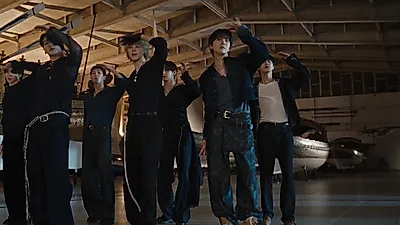
If the rules of the infected have been renewed, the next question is why this should be seen in a theater. Colony puts the answer in space and the body. The press kit says the production combined actual locations with a set recreating a 33-story building, and that it tried to realize the infected's movements through physical performance rather than relying primarily on VFX. The detail that 20 professional dancers took part in the infected movement shows where the film's experience design is located.
The official trailer points in the same direction. Dark corridors, the vertical structure of a high-rise building and everyday spaces reminiscent of a shopping mall are sealed off, and the characters are pushed not across a broad battlefield but through compressed routes. Images of infected people tilting their heads back in the same rhythm, or shifting from quadrupedal movement to upright motion, function more powerfully on a large screen and through theatrical sound than they do when viewers merely follow the plot on a small screen. What Colony has sold is not simply zombie material, but a way to experience bodily movement and spatial pressure together.
This also aligns with the current conditions of Korean commercial cinema. In a market where genre works continue to be supplied on platforms, theatrical films have to overcome how easily their stories can be summarized. If it is enough for viewers to consume only an explanation of the ending at home, the reason to go to a theater weakens. Colony foregrounds the material presence of the infected, the pressure of crowds and the layered feeling of a sealed building, creating a sensation that is difficult to replace with a summary.
Jun Ji Hyun's return is not only star news, but a matter of role placement. She chose Colony as her first screen comeback in 11 years since Assassination, playing Kwon Se-jeong, a biotechnologist who leads a group of survivors. The reason this return is not consumed simply as buzz is that her function within the genre is clear. In a zombie story, the figure the audience holds onto is not the person who explains the fear, but the person who pushes judgment forward inside the crisis.
Koo Kyo Hwan's Seo Yeong-cheol forms the opposite axis. He is introduced as a character who claims that he is the only vaccine, and in the official trailer he is positioned as someone who heightens tension within the survivor group. In Yeon Sang Ho's genre works, villains have been used not merely as obstacles but as devices that expose cracks in a system. In Colony as well, Seo Yeong-cheol pushes forward the question of who gives up their humanity, rather than only who has been infected.
The ensemble that extends to Ji Chang Wook, Shin Hyun Been, Kim Shin Rok and Go Soo does not narrow this world into the story of a single hero. What repeats in the official materials and trailer is a structure in which family, occupation and survival decisions collide inside one building. Everyday space that audiences recognize is sealed off, and within it each person's ethics and interests are put to the test. Colony's casting does not function as a simple lineup of stars, but as a device that distributes power and distrust inside a closed space.
Colony's 4 million admissions also carry meaning within this year's lineup from distributor Showbox. According to related reports, Showbox continued a run of titles passing their break-even points with Once We Were Us, The King's Warden, Salmokji: Whispering Water and then Colony. In particular, Colony passed its break-even point after exceeding 3 million admissions on its tenth day, then maintained its pace to 4 million. The important issue is not whether big films can still call audiences out, but what kind of big film gives audiences a reason to go to the theater.
It is also notable that this year's box office cases are divided across romance, period drama, horror and zombie films. The market is not being led by one particular star or a single genre; rather, works with distinct viewing experiences are gathering audiences in sequence. Colony belongs to the axis with the strongest genre color among them. When infected movement, sealed space, large-scale action and dark sound design are bound together, audiences buy tickets again even for zombie cinema they already know well.
Still, variables remain for a long box office run. After 4 million, the drop-off rate and seat occupancy become more important than the speed of the milestone. If weekday attendance and reservation-rate defense continue through the first weekend of June, 5 million becomes the realistic next target. On the other hand, if the early buzz is exhausted and genre preferences split more sharply, Colony may remain a film with a fast early run. Its next report card will be determined by seat occupancy in the third weekend, reservation rates after new competing releases enter the market and whether audience word of mouth around the infected setup continues.
In conclusion, K-zombies need updating more than repetition. Colony's passage beyond 4 million cannot be neatly reduced to the simple statement that K-zombies still work. More precisely, it is a case that shows what a familiar genre has to change in order to function again in theaters. When the rules of the infected are altered, a star comeback is connected to the function of a role, and everyday space is transformed into theatrical pressure, audiences respond again even to a genre they already know.
That is why the question after Colony is broader than whether there will be a sequel. For Korean genre films to compete in theaters rather than on platforms, the key is how fully they can design sensations that audiences cannot replace with a summary at home. The final box office evaluation of Colony will not be settled only by whether it passes 5 million admissions. The longer checkpoint is whether its three elements, evolved infected, sealed-building action and an ensemble survival drama, expand into an actual grammar for later K-genre works.
Related articles