Pilgrims: How to Bring Literary Readers Into Theaters
Ahead of its June 3 CGV-exclusive release, this emotional sci-fi animation turns Kim Cho-yeop’s prose into a theatrical experience.
Why Don’t the Pilgrims Come Back? is an emotional sci-fi animated film opening exclusively at CGV on June 3, 2026. The film is based on the short story of the same name from Kim Cho-yeop’s story collection If We Cannot Move at the Speed of Light, with Kim Hyang-gi, Park Ji-hu, and Lee Ju-young participating as voice actors. What makes the project interesting is not only the name value of a bestselling work. By rearranging questions that were once read as text into an experience that can be heard and seen inside a theater, it attempts a different way of defining the audience for Korean animation.
The official teaser poster makes that direction clear. Most of the image is occupied by outer space, while a single streak of light falls diagonally toward Earth. Rather than placing a character’s face at the center, the poster shows distance, direction, and destination first. It makes viewers ask not “who appears in it,” but “why are they going there?”
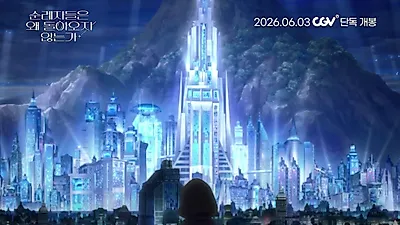
The strength of the original lies in its questions more than in its setting. The story asks why people raised in a world without sorrow or pain would choose an imperfect Earth. In the world described by the official synopsis, there is a rule that once people turn eighteen, they must go on a one-year pilgrimage to Earth, and some pilgrims never return. The sci-fi premise may feel unfamiliar, but the question is deeply ordinary: can one choose imperfect love over perfect safety?
That is where the film begins from a different starting line than an ordinary new animated release. The original story collection has been introduced as a work that sold more than 400,000 copies after its publication in 2019. That means there is already an audience that first encountered the work through sentences. Yet those readers are not simply viewers who want to see the plot repeated. They are closer to an audience checking how the emotions they remember have been transformed into the colors of the screen, the breathing of the characters, and the spaces left open by the music.
The CGV-exclusive release narrows the path while sharpening its meaning. CGV has placed the film within its June exclusive content lineup, titled If You Go to CGV. The same lineup includes horror, fantasy, music films, and live performance screenings. This placement speaks a different language from large-scale distribution competition. It is closer to the phrase “taste-driven content selected at the theater” than to “the biggest movie.”
That is also why the relay GV schedule matters. The structure brings Kim Cho-yeop, astronomer Shim Chae-gyeong, actor Park Jeong Min, the voice cast, and music director Hwang So-yoon into encounters with the audience. It is not merely an event that adds commentary, but a device that expands the way the film can be watched. This work depends less on a story that ends when one finishes watching and more on questions that viewers want to talk about afterward. An exclusive release limits the screening route, but it also has the effect of gathering those conversations under one theater brand.
The most delicate part of the adaptation is not the amount of incident, but the shift in point of view. Publicly released production-related material confirms that Sophie’s presence became larger in the process of translating the original’s letter format into cinematic form. This is less a choice made to explain the original more kindly than a task of moving the place once occupied by the reader’s imagination toward the movements and voices of characters.
Animation cannot easily make viewers stop and think for a long time in the same way a sentence can. Instead, it builds emotion through the direction of light, the distance between people, the pace of dialogue, and the moments when music falls away. That is also why the casting of Kim Hyang-gi, Park Ji-hu, and Lee Ju-young carries weight. It is not the faces of the three actors but the texture of their voices that must persuade the audience of the lacks and choices of Sophie, Daisy, and Olive. No matter how beautiful the worldbuilding may be, if the characters do not waver, this story will recede into the distance.
The film received the Technology Award, presented by the Korea Animation Industry Association, at the 27th Bucheon International Animation Festival, and it has also been introduced as an official selection of the 50th Annecy International Animation Film Festival. That record creates expectations for the film’s level of completion. But the core of this release is not the awards history itself. It is how much that history can narrow the gap between readers of the original and new viewers.
In Korean theaters, emotional sci-fi animation aimed at adult audiences is still not a familiar choice. For that reason, the first responses left by Why Don’t the Pilgrims Come Back? need to be more specific than “well made.” Fans of the original must be convinced by the change in point of view, non-readers must not feel the worldbuilding as homework, and the voice acting must let the sense of lack be heard rather than explained. If those three responses emerge together after June 3, this work could show more clearly how animation based on literature can call audiences into theaters.