Cortis' First Tour Tests Whether Chart Momentum Can Fill Seats
Cortis will launch its first solo tour in July 2026, testing whether strong album and chart results translate into live demand.
Cortis will open its first solo tour, 'PUT YOUR PHONE DOWN,' on July 18, 2026, starting in Incheon. The schedule is built around 13 performances across nine regions: Incheon, Toronto, New York, Atlanta, Irving, Los Angeles, San Francisco, Seoul, and Kanagawa, Japan. What makes the tour important is not only its size, but its order. It will be the first stage on which the chart performance confirmed by the rookie boy group's second mini album, 'GREENGREEN,' is tested against actual audience demand in North America and Japan.
The tour begins with two shows on July 18 and 19 at Inspire Arena in Incheon. It then moves to Toronto on August 4, New York on August 6, Atlanta on August 8, Irving on August 11, Los Angeles on August 13, and San Francisco on August 15, before returning to Hwajeong Gymnasium in Seoul for concerts on August 22 and 23. The final leg consists of three performances from September 4 to 6 at Pia Arena MM in Kanagawa, Japan. The Seoul concerts also carry the character of a 'BIRTHDAY PARTY,' timed around the first anniversary of Cortis' debut.
For a rookie boy group's first tour to go beyond a domestic commemorative performance and include six North American cities plus three days in Japan is not a minor choice. This is less about creating a single burst of attention through one large-scale show and more about checking the density of the fan base and the purchasing path across multiple cities. For that reason, the key point of this tour is not simply whether each stop sells out. The consistency of audience response from city to city will become the standard for deciding the scale of Cortis' next tour.
The backdrop that made this tour possible is the group's recent set of numbers. 'GREENGREEN' entered the Billboard 200 at No. 3 and recorded 87,000 album units in the United States during the tracking week. In Korea, the title track 'REDRED' reached No. 3 on Melon's monthly chart for May, while the album ranked No. 1 on Hanteo Chart's May monthly tally with sales of 2,518,122 copies. The fact that sales continued after first-week sales of 2.31 million copies suggests that the fandom's purchasing power was not confined to a single round of preorders.
Cortis' key 'GREENGREEN' indicators can be separated into three figures: 2,518,122 copies sold on Hanteo's monthly chart, 2.31 million copies in first-week sales, and 87,000 weekly album units in the United States.
Still, album sales and concert draw are not the same number. Albums can grow quickly through concentrated fandom purchases and version strategies, but tours must pass through city-by-city ticket prices, travel distance, local promotion, ticketing systems, and venue selection. At this point, Cortis' first tour tests the simple conclusion that strong chart results automatically lead to successful concerts. Charts are the starting line; seats are a separate market.
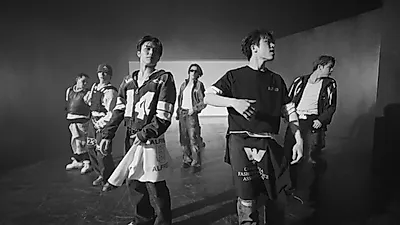
In the official announcement materials, the tour title 'PUT YOUR PHONE DOWN' was explained as a message to immerse oneself in the live performance and jump together with the artists. The released poster also places black-and-white movement, with a sense of motion, at the front rather than a static portrait. Instead of a promotional image that clearly displays the members' faces, the choice first evokes the felt energy of the stage and audience participation. This image strategy can be read as a signal that Cortis wants to position itself less as a team to be watched passively and more as a team that draws reactions on site.
That approach also comes with the particular task facing a rookie team. The repertoire for a first tour is inevitably limited, so the flow between songs, spoken segments, audience interaction, and stage transitions have to fill the gaps. During its new-release promotions, Cortis has used a 'RELEASE PARTY' format that presented B-side tracks live first. That experience may become a device for proving stage stamina on the actual tour, but to persuade repeat attendees as well, the rise and fall of the setlist will matter more than simple performance intensity.
Just before the North American leg, Cortis is scheduled to appear at Lollapalooza Chicago on August 1. A House of Blues Chicago aftershow is also planned for the previous day, creating a structure in which the group meets festival audiences and core fans in succession. The order is efficient from a promotional standpoint. A festival is a place where the team can be exposed to audiences who do not yet know it deeply, while an aftershow gathers highly immersed listeners in a closer space.
The question is whether that exposure will connect to seat demand from Toronto through San Francisco. A No. 3 entry on the Billboard 200 is enough of an indicator to make the group's name known in the U.S. market, but concert venues are more unforgiving than charts. Audiences respond not to rankings, but to the density of a stage sustained for more than an hour and to satisfaction in the room. If the gap between the six North American cities is small, Cortis' overseas performance can be explained by more than fandom purchasing power.
There are four indicators to watch on this first tour: the completeness of the setlist at the opening Incheon concerts, the audience response to the North American shows immediately after Lollapalooza, the fandom's ability to gather for the first-anniversary Seoul concerts, and local Japanese demand across the three Kanagawa performances. The Japan leg is especially important because three consecutive days of concerts can measure both repeat viewing and new audience inflow.
Cortis has already become a team that draws attention through numbers. The remaining question is whether those numbers remain as evidence of seat density and a basis for expanding the next tour. The conclusion of this tour should be judged not by how many shows were held, but by which cities create grounds for moving to the next level of venue. The answer will be built through city-by-city responses from the first Incheon stage in July to the final Kanagawa concert in September.
Related articles