Hope brings Na Hong-jin's 160-minute Cannes risk home on July 15
Na Hong-jin's SF action film Hope opens in Korea on July 15 after Cannes, 200-territory presales and debate over its 160-minute runtime.
Director Na Hong-jin's new film Hope will open in Korean theaters on July 15. The project has already been sold in advance to about 200 countries and territories, giving it a rare level of international reach before its domestic release. For Korean moviegoers, however, a separate question remains: whether a 160-minute science-fiction action film that was shown first at Cannes can hold theater audiences through to the end.
Hope has clearly achieved a major result in overseas sales, but the response after its Cannes unveiling did not move in only one direction. Ahead of its July release, the weight around the film appears to rest less on how much attention it has drawn and more on whether its finished quality can justify both its large production cost and its long running time.
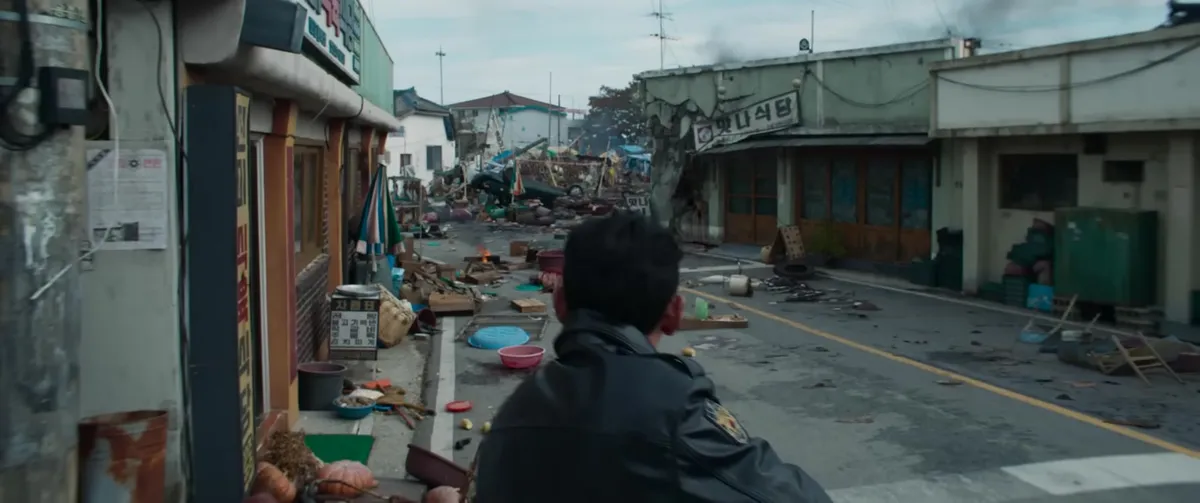
Hope is set around Hopo Port near the Demilitarized Zone. The story follows Beom-seok, the head of a local branch office, as he moves after hearing news of a tiger sighting and then encounters an unfamiliar being that has overtaken the village. The cast is also large in scale. Hwang Jung-min, Zo In Sung, and Jung Ho-yeon stand at the center of the Korean ensemble, while Michael Fassbender and Alicia Vikander are also listed among the cast.
The overseas sales performance is unmistakable. KoBiz, the English-language outlet of the Korean Film Council, reported that Hope was presold to about 200 territories around the Cannes period, and that Plus M Entertainment described the figure as the highest overseas presale record for a Korean film. In the same article, director Yeon Sang Ho's Colony was mentioned as another case, having been sold to more than 120 territories. Together, the two films show that Korean genre cinema can attract overseas distributors before screening to the public.
Still, overseas sales do not automatically guarantee domestic box-office success. A presale means that foreign distributors believe they can sell the film in their own markets. Korean audiences, by contrast, need their own reason to buy a ticket, sit in a theater, and give 160 minutes to one film. The task Hope must solve in July is to narrow precisely that gap.
The next point to examine after the overseas sales is the reaction that followed the Cannes screening. Hope was first shown in the competition section of the 79th Cannes Film Festival, and its running time has been reported as 160 minutes. Reports also said the screening was followed by a standing ovation lasting about seven minutes. Taken by itself, that number suggests that attention in the room was not small.
But the length of applause alone cannot define the quality of a film. After Cannes, some responses praised the strong action and the film's unfamiliar creature-feature quality, while others expressed disappointment about how the story was organized or about the polish of its computer graphics. That split reaction may reveal that Hope is not a standard summer movie, but a work with a different texture and risk profile.
That is also the point that matters for domestic audiences. Na Hong-jin's previous films, The Chaser, The Yellow Sea, and The Wailing, are remembered for intense suspense and harsh emotional force. Hope appears to push that tension far toward creatures and science-fiction action. The first hurdle may be whether audiences who enter trusting the director's name accept it as a Na Hong-jin film, or instead feel that it is a blockbuster that has moved too far into another register.
In the official international trailer, the first thing that stands out is the space rather than the faces of the stars. Old village streets, damaged buildings, police cars, and chase scenes in the forest pass by quickly. Even after foregrounding the title in large lettering, the trailer does not linger on a full explanation of the creature's appearance. It first shows people being chased by something.
That choice is significant. What Hope has to sell to audiences is not simply a creature design. It is the feeling that a familiar small Korean village has suddenly turned into the site of an unknowable disaster. The power of the trailer therefore lies less in what has appeared than in how far an ordinary place has collapsed.
This approach also creates a link for viewers who know Na Hong-jin's earlier work. The director has often used situations in which characters are pushed into circumstances they do not understand, rather than explaining the cause of an incident from the beginning. Hope appears to translate that feeling onto a larger screen and into faster movement. At the same time, the larger the screen becomes, the more easily weak images can be seen. That is why the result of the remaining post-production work before release has become important.
A 160-minute running time is not something the summer box office can treat lightly. From the audience's point of view, once travel time is included, choosing the film can become close to a half-day commitment. From a theater's point of view, it is also harder to schedule many screenings. The longer the film is, the more important word of mouth becomes.
That does not mean a long film is automatically at a disadvantage. If the large action scenes work fully and the characters' emotions follow through, the running time can turn into the satisfaction of feeling that the ticket was worth the price. If gaps in the story become visible, however, the same 160 minutes can become exhausting. Hope stands directly at that fork in the road.
The production cost adds to the burden. Korean reports have said the film cost somewhere in the 50 billion to 70 billion won range to make. That figure has not yet been confirmed identically across multiple official materials, so it is difficult to state it as settled fact. Even so, it is clear that Hope is not an ordinary-scale genre film. Overseas sales have already provided support, but after the Korean release, its report card will be written through admissions, ratings, and word of mouth from viewers who have endured the long running time.
Na Hong-jin has said he accepts the sharp reactions he received at Cannes and intends to concentrate on post-production, including computer graphics, before the July release. That statement shows exactly where Hope now stands. It has already won attention from the overseas market. Now it must persuade domestic audiences as a completed film.
After July 15, it will be difficult to judge the film by its first-day ranking alone. What will have to be checked in sequence is how actual viewers talk about the long running time, whether they accept creatures and science-fiction action naturally within the setting of a Korean village, and how much the final post-production has reduced the concerns raised after the Cannes screening.
Hope became a big film even before its release. Its presale to about 200 countries and its invitation to the Cannes competition section explain that scale. But the judgment that remains in theaters is simpler. Whether viewers can leave after 160 minutes and recommend it to people around them will soon be revealed in the July box office.
Related articles