Jung Kook's CKJK: The Fandom Economy Behind $3.4 Million in Media Value
BTS member Jung Kook's Calvin Klein collaboration shows how K-pop fandom can convert attention into fashion value.
BTS member Jung Kook's "Jung Kook for Calvin Klein," widely referred to as CKJK, shows how a fandom-driven conversation can be converted into tangible product appeal and measurable media value for a fashion brand. In the 48 hours after the collaboration was unveiled, its media impact value, or MIV, was calculated at $3.4 million. A short teaser video released on May 15 alone generated $908,000 in MIV. This article examines why Jung Kook's CKJK is not simply another ambassador campaign, but a global fashion experiment built around the intellectual property of a K-pop artist.
The first thing that defines the collaboration is the set of numbers attached to it. Those figures, however, have to be read narrowly and accurately. MIV is not sales revenue. It is an estimated measure of the media value created for a brand through social media and news exposure. In that sense, the $3.4 million figure says less about how much product was sold and more about how quickly the launch dominated the brand conversation immediately after release.
The $908,000 generated by the teaser video accounted for about 26.7 percent of the total early MIV. That proportion matters because the official clip was only around ten seconds long, yet it was responsible for more than a quarter of the collaboration's initial value. The response suggests that the fandom reacted faster to a single moment implying the artist's direct involvement than it might have to a longer, more explanatory advertisement.
The early CKJK MIV comparison was clear: total MIV for the first 48 hours after release stood at $3.4 million, while the May 15 teaser video produced $908,000. On the chart, the comparison was presented with the 48-hour total and the teaser video as the two categories, using ten-thousand-dollar units.
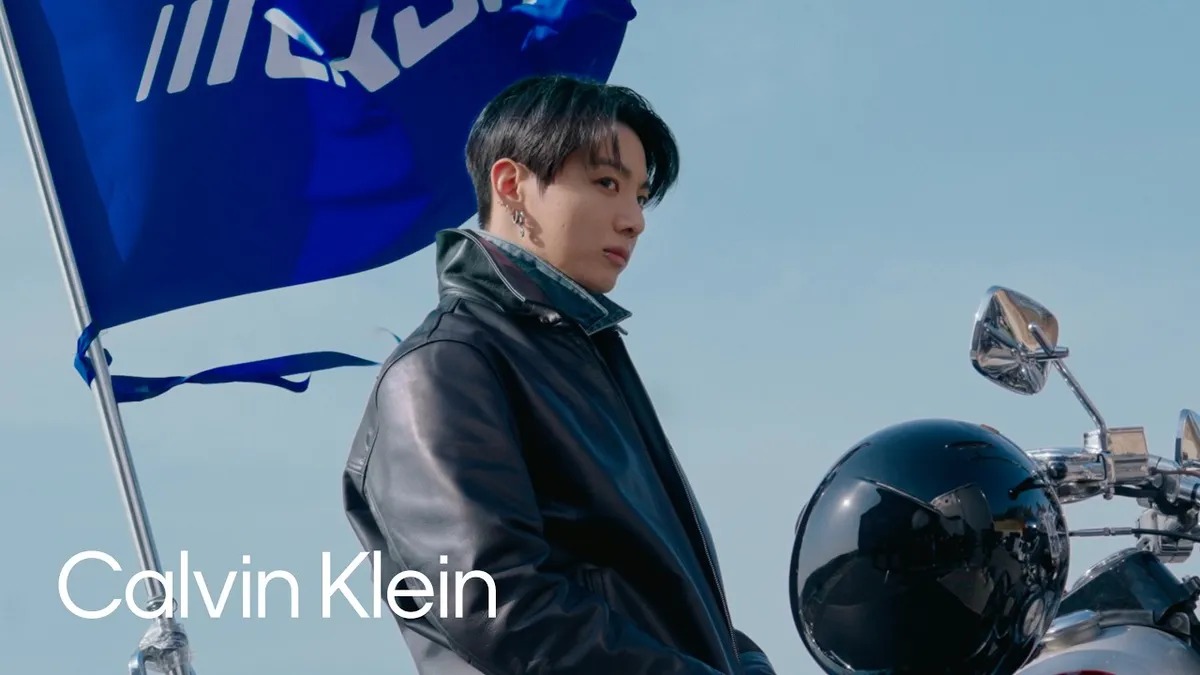
Still, numbers alone do not fully explain CKJK's force. The first images emphasized in the official campaign video and product pages are motorcycles, leather jackets, denim, a "1997" license plate, and the CK flag. The campaign translates Jung Kook's birth year and his riding taste into visual language, then attaches that language to Calvin Klein's 1990s silhouettes. The difference is that this is not merely an advertisement borrowing a famous face. It is a campaign that turns the artist's taste into the structure of the product itself.
Based on fashion industry coverage and Calvin Klein's official sales pages, the collection was designed as a capsule line including products for men and women. Core items included denim trucker jackets, straight and baggy denim, graphic T-shirts, sweatshirts, and racer jackets. The pieces incorporated CKJK logos, interior labels, embroidery, and dedicated packaging. For fans, the stronger reason to buy may not be simply that the item is "clothing Jung Kook wore," but that it is an object carrying traces of Jung Kook's taste. That distinction helped amplify both the MIV and the signals of sellouts.
The scale of demand could also be seen in how the products were sold. Calvin Klein Japan's official online store announced that sales would begin at 7 a.m. on May 20, that the collection would be available at seven stores, that entry through LINE numbered tickets would be used for part of the period immediately after launch, and that purchases would be limited to one item per person for the same product number and same color. Underwear was the exception, with up to seven items allowed per person for the same product number and same color. These rules show an operating plan built on the assumption that concentrated fandom purchasing would occur.
The official notice also stated that online restocks for all products were undecided. In a limited edition collaboration, uncertainty over restocks is not just scarcity marketing. It compresses the time consumers have to make a purchase decision. In Jung Kook's case, that compression overlapped with simultaneous access by a global fandom. Some overseas reports said 36 items on the U.S. site sold out within 30 minutes and that all sizes of some products in China sold out within one minute. Because those figures come from reports using different regional standards, however, they cannot be expanded into a claim about total sales scale.
The key point of CKJK does not end with the idea that Jung Kook created another sellout. When the intellectual property of a K-pop solo artist meets the design language of a global brand, fandom becomes part of product planning rather than merely a target for promotion. The brand uses the artist's narrative to reach younger consumers quickly, while the artist has his taste tested in a market outside music.
Jung Kook has served as a global ambassador for Calvin Klein since 2023. This collection is significant because that relationship moved from campaign modeling to collaborative product. In the K-pop industry, people are accustomed to reading fandom concentration through numbers such as first-week album sales, streaming, and tour revenue. CKJK shows that the same concentration can extend into fashion products, official video views, store operations, and sellout coverage.
The next checkpoint is not simply whether the items are restocked. First, the question is whether Calvin Klein ends CKJK as a one-off limited edition or expands it into follow-up collaboration lines. Second, it matters whether MIV leads to actual repeat purchases and new customer inflow. Third, the industry will be watching whether other K-pop artist collaborations move beyond simple model casting into design-participation capsules.
The $3.4 million figure is only the starting point. CKJK's real result will not be judged solely by the attention generated in the first 48 hours after launch, but by whether the speed created by fandom can influence the brand's next round of product planning.