In Hope, Seong-ae and Jung Ho-yeon's Action Become the Variables to Watch
Na Hong-jin's Hope puts Jung Ho-yeon's first major action test inside a Cannes Competition genre film with global market ambitions.
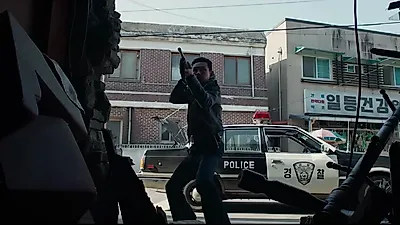
In Hope, the character played by Jung Ho-yeon is named Seong-ae. She is a police constable at the Hopo Port police outpost, a figure left behind in a village after firefighting support has been pulled away and communications have been cut, and one of the people who, together with Beom-seok, must hold the line for a community where only elderly residents remain. Director Na Hong-jin's 2026 feature is a 160-minute Korean genre film invited to the Competition section of the 79th Cannes Film Festival, and Jung's preparation for gun action and car-chase work has to be read within that large-scale genre machinery.
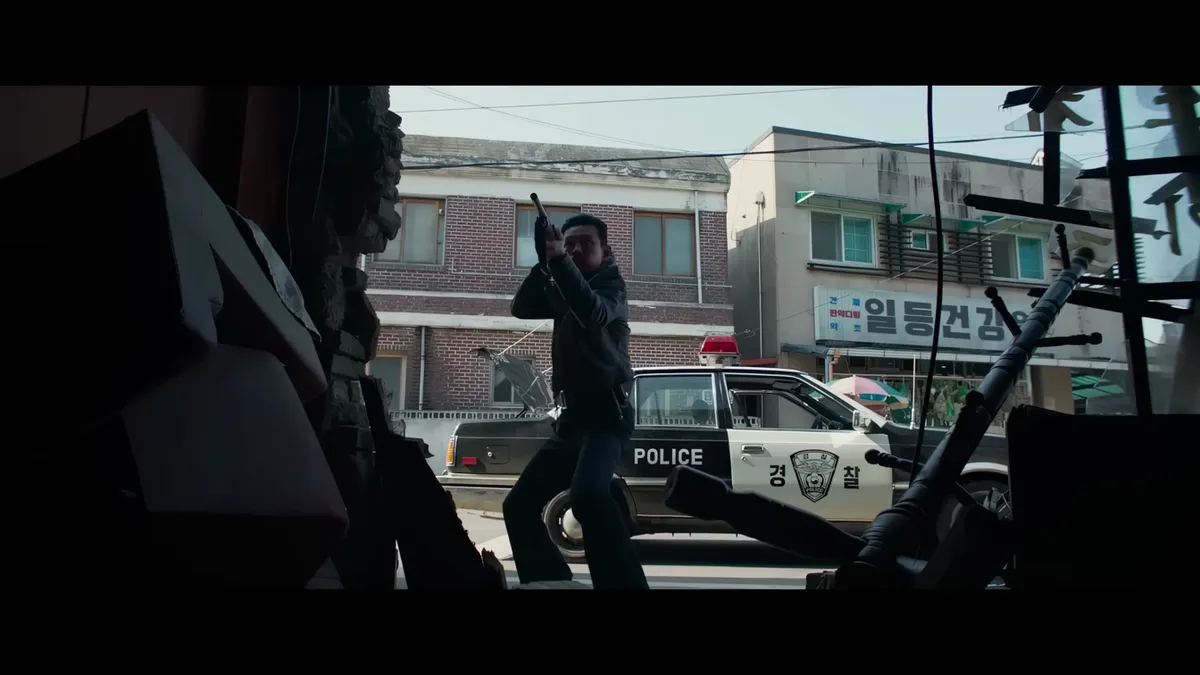
For Seong-ae, Jung Ho-yeon learned how to handle firearms and how to take shooting positions. She also prepared for driving her own car-chase scenes by obtaining a Class 1 regular driver's license and training in drifting. This article looks at how Jung's first action challenge becomes a test in her expansion as a global actor after Squid Game, and how Hope, through Cannes Competition and a North American theatrical release, may shift the overseas-market grammar of Korean genre cinema.
Within the disaster drama of Hopo Port, Seong-ae occupies a crucial position. The starting point of Hope, as presented in official Cannes information, is not simply the appearance of a monster. With support personnel diverted to respond to a wildfire and communications blocked, Hopo Port branch chief Beom-seok and constable Seong-ae must protect a village where elderly residents have been left behind. In the mountains, Seong-gi and the residents shift from pursuers into the pursued. Ignorance becomes the seed of disaster, and human conflict expands into a cosmic tragedy.
In that structure, it is difficult for Seong-ae to remain only a supporting character used for exposition. She has the professional function of a police officer guarding the village, and in a genre space where monster elements, disaster, gunfire, and pursuit overlap, she has to judge the situation physically. That is why Jung Ho-yeon's action preparation is not merely a warm behind-the-scenes story about an actor's effort. It is a question of character credibility. If Seong-ae falters, the audience will find it difficult to believe in Hopo Port's defensive line.
The official trailer points in the same direction. Images of a devastated village, police cars, firearms, and chase scenes follow one another rapidly, while the film moves through the boundaries of monster movie, mystery thriller, and disaster action all at once. What is needed in that moment is not lengthy explanation but immediate response. That is why Jung has to make Seong-ae's judgment persuasive through the speed of her body and the handling of her gaze.
Hope also creates a different starting line for director Na Hong-jin. After The Chaser, The Yellow Sea, and The Wailing, all of his features have been unveiled at Cannes, and this film is the first of his works to compete for the Palme d'Or in the Competition section. The film also arrives in the context of Korean cinema once again testing the weight class of genre filmmaking in Cannes Competition after Park Chan Wook's Decision to Leave.
The same pressure applies to Jung Ho-yeon. For an actor who gained worldwide recognition through Squid Game, the next stage is not about proving fame but proving function inside a work. Seong-ae in Hope reads as a role in which movement comes before dialogue, reaction speed before facial expression, and crisis response before emotion. If the action feels awkward, the entire character may wobble. If the rhythm of the body comes alive, Jung can create her own place even within a globally cast production.
Jung said, "While filming, I felt like I was reaching a point where I was going beyond my limits, so it was very enjoyable." The sentence shows the direction of the training more than a promotional declaration of resolve. If Seong-ae has to be a person who actually runs, drives, aims, and judges on the scene, then emotional preparation alone is not enough for the actor. Hope becomes a stage on which Jung's ability to perform genre action is publicly tested.
Hope begins from the locality of a Korean port village, but its casting is far wider. Hwang Jung-min, Zo In Sung, and Jung Ho-yeon are joined by Michael Fassbender, Alicia Vikander, Taylor Russell, and Cameron Britton. The official Cannes information also confirms cinematography by Hong Kyung-pyo, music by Michael Abels, and a production and sales axis involving Plus M Entertainment, Forged Films, and Westworld.
That combination shows a change in the way Korean genre cinema is approaching overseas markets. If earlier overseas expansion often meant exporting a completed Korean film, Hope is closer to a project that embraced international actors and North American distribution signals from the planning stage. In North America, a theatrical release is scheduled for September 9, 2026, and a review-aggregation site lists an 82 percent Tomatometer score based on 38 reviews. With no audience indicators available yet, what can be confirmed for now is not the level of audience demand but the early critical response and the release strategy.
At the same time, this genre expansion carries risk. A 160-minute monster, action, and mystery film can easily draw the curiosity of fandoms, but for general audiences the balance of pace and emotion will be the key issue. For overseas viewers, genre rhythm lowers the entry barrier before subtitles do. Jung Ho-yeon's direct action becomes information that can be transmitted without translation at precisely this point.
The next points to watch for Hope are now threefold. First, how much sustained screen time Jung Ho-yeon's own action receives in the finished film. Second, whether Seong-ae has an axis of judgment in the events rather than serving as a simple assistant between Beom-seok and Seong-gi. Third, whether overseas critical curiosity after Cannes leads to choices by theater audiences in Korea and North America.
A simple early-stage promise of "presence" is not enough to explain this film. Hope is a project where Na Hong-jin's entry into Cannes Competition, major international casting for Korean genre cinema, and Jung Ho-yeon's shift toward action acting meet at one point. For Jung, it is a test of whether she can prove her next image. For Korean cinema, it is another test of whether genre scale can be verified in the overseas theatrical market. A judgment will be possible only after the completeness of the action and Seong-ae's narrative function are confirmed together after release.